Qubit Teams: The Future Built by Two
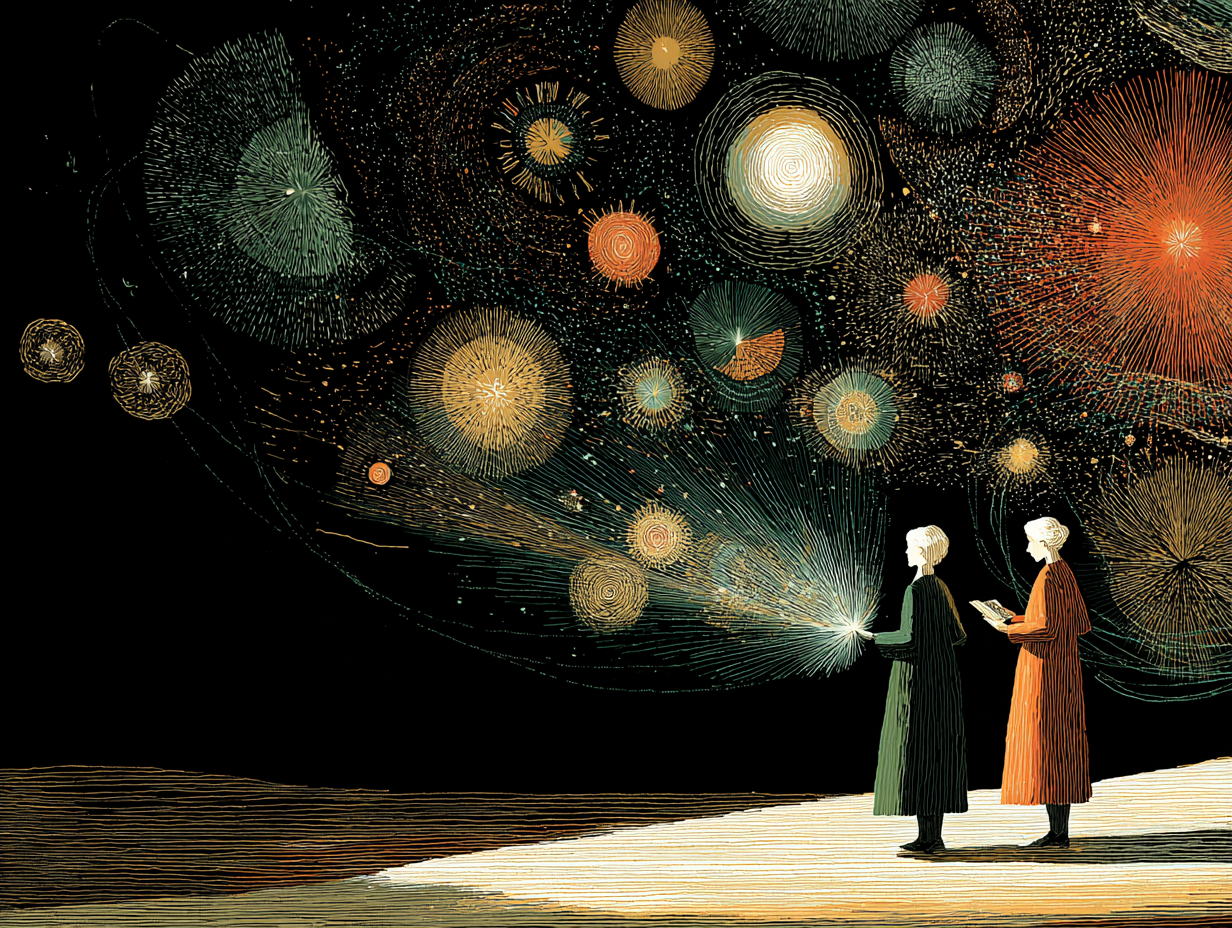
The smallest meaningful unit of invention has changed.
For decades, a team of eight or ten could build future products. Now, two people augmented with AI can do the same work, and more.
Jeff Bezos once offered a rule of thumb that became gospel in the tech industry: a product team should be small enough to be fed with two pizzas. It was more than a joke about appetites. It was a parable about focus.
In the era of high-performance product cultures, when every release demanded painstaking coordination, “two-pizza teams” became a way to import startup speed into lumbering corporations. A self-contained group of eight to ten could move without drowning in process. Scarcity sharpened judgment. Fewer voices meant clearer decisions. The pizza was a metaphor for constraint as much as camaraderie.
For two decades, that model framed modern product development. I built my own career inside it, leading teams tasked with inventing new products. The formula was predictable:
One product-minded leader to set the vision and prioritize ruthlessly.
A handful of engineers to bring technical rigor and dissent.
And, depending on the domain, a designer or subject-matter expert—a clinical researcher for a health-tech launch, say.
These teams were designed to birth a version-one product worth betting on. They were the minimal unit of invention in a pre-AI world, when hypotheses were researched painstakingly and prototypes were built the slow way.
But a tectonic shift is underway. Artificial intelligence has not only changed how software is built. It is rewriting the social physics of innovation.
Today’s systems accelerate the slowest work: market research, hypothesis testing, concept generation, even the first build of working products. Tasks that once required ten people now collapse into one. The two-pizza team, once a symbol of radical efficiency, suddenly looks quaint.
The uncomfortable progression follows: to conjure new products, we no longer need eight or ten. We need two.
I call them Qubit Teams, a metaphor from quantum computing, where a qubit can exist in multiple states at once.
In a traditional team, vision and execution were binary: one came before the other. In a Qubit Team, those states are held in superposition, bound together by AI. The Vision-Qubit and Reality-Qubit operate not in sequence but in simultaneity, collapsing the distance between what can be imagined and what can be built. The result isn’t a smaller team doing the same work faster, but a new unit of creation. A structure that evolves ideas and systems together.
The Two Qubits
Classical teams treated vision and execution like a relay race: first the idea, then the plan, then the build. Vision was upstream, Reality downstream. One bit flipped, then the other.
In a Qubit Team, these states exist at the same time, continuously influencing one another. AI acts as the entangling field, allowing Vision and Reality to coexist without destructive interference.
The Vision-Qubit is possibility: sensing patterns in culture and markets, framing bold bets, imagining futures that don’t yet exist.
The Reality-Qubit is precision: grounding those bets in systems that can endure, scaling the fragile prototype into something the world can rely on.
These aren’t static roles so much as oscillating states.
During exploration, Vision surges forward while Reality focuses on systems. As experiments harden into products, Reality takes the lead without snuffing out Vision. Both are always present, always entangled.
AI makes this simultaneity possible. It absorbs the churn of research, scaffolding, systems architecture, and iteration, freeing humans to focus on what machines cannot: direction, taste, and strategic judgment. The rare decisions that separate fleeting novelty from lasting creation.
The Rise of the Vision-Qubit
The Vision-Qubit’s work begins with pattern recognition: seeing around corners, reading culture, tracing weak signals in markets. Historically, these people were constrained by execution. Vision didn’t build. It mobilized.
AI breaks that dependency.
For the first time, a single person can think and build at once. The Vision-Qubit moves with a portfolio mindset, running many small, parallel bets rather than one brittle, high-stakes gamble. Research that once took weeks now takes hours. Design explorations that once demanded a team arrive in minutes. Prototypes appear, get tested, and vanish within days.
What remains scarce is not code but discrimination: the capacity to ask the right questions, isolate decisive signals, and kill most ideas quickly.
The mandate is simple: cast a wide net, then narrow with conviction. When an experiment throws off real signal, attention tightens and the work shifts from breadth to depth.
But as soon as an idea graduates from prototype to product, the fragile harmony collapses. A concept that sings in a local environment will almost certainly break under the pressures of traffic, compliance, latency, security, or integration debt. This is where the second qubit becomes indispensable.
The Reality-Qubit and the Market
The Reality-Qubit is the guardian of scale.
These leaders have built systems that survive production: distributed architectures, unforgiving edge cases, enterprise-grade constraints. Their value is not speed for its own sake but soundness. Making sure what’s built will last.
While Vision experiments, Reality builds systems for experimentation itself: reusable foundations that make the next test faster and cleaner than the last.
Modular design systems that don’t require a full rebuild for every new idea.
Deployment pipelines that snap into place instead of being reinvented.
Microservice patterns and data contracts that let prototypes mature without wholesale rewrites.
When an idea clears the bar, the two qubits converge.
In an AI-native workflow, the Vision-Qubit might generate a week’s worth of features in an afternoon. Too much for traditional review rituals.
Reality doesn’t throttle that speed. Instead, it codes the guardrails into the environment itself. Models are trained on the organization’s standards so code is born compliant: secure by default, observable by default, test-first by default. Quality becomes proactive, not reactive.
Sprints, merge queues, and ticket ping-pong give way to orchestration: systems that preserve speed and standards.
The point is not to remove humans from the loop, but to break the loop, shifting focus from line-by-line inspection to architectural intent and continuous verification.
The Entangled Dance
On an ordinary day, Vision runs a dozen experiments: new user flows, A/B tests, bold new feature spikes, whole-cloth concepts. Their agents pull data, draft copy, sketch interfaces, synthesize findings. Only the most promising artifacts reach human review.
Meanwhile, Reality tunes the substrate: build times, rollback paths, model constraints, dependency hygiene. The goal is a higher baseline tomorrow than today.
When a breakthrough appears, the pair switches stance in the same hour.
Vision shifts from exploration to focused execution.
Reality shifts from platform to product architecture.
No hand-off meetings. No transition plans.
The system itself carries the context because it was designed that way.
This systems relies less on hierarchy. Rather it focuses on oscillation: possibility and precision, curiosity and constraint, woven together and augmented by AI.
The Future Stack for Qubit Teams
Today’s toolchains were built for a world of human bottlenecks: commits, tickets, review queues.
Useful? Yes. But misfit for two humans working alongside a fleet of agents.
The next stack will be built for machine speed:
Continuous agents running in the background, not as chat threads—fuzzing APIs, hardening authentication, profiling performance, writing and running tests as code changes.
Context clouds where models reason over a company’s patterns, risks, and history securely, so the environment itself enforces taste and policy.
Self-healing pipelines that detect architectural drift and propose fixes before incidents happen.
In that world, the pair is less a “team of developers” and more conductors of a living system.
Their labor is judgment: what to amplify, what to cut, when to override the automation.
Why This Matters
The two-pizza team was never about calories. It was a hedge against human limits: meeting overhead, coordination drag, the politics of headcount. A team of eight or ten was small enough to be nimble and large enough to hold the skills required to ship.
Qubit Teams arise from a different logic.
Two people, amplified by AI, don’t replicate a small department. They reshape the product innovation function itself.
Where the two-pizza team was built for scarcity—of time, talent, iteration—Qubit Teams operate in abundance: near-zero marginal cost for another experiment, near-instant access to scaffolding, near-continuous verification.
This doesn’t just change how products are built. It rewires the enterprise.
When a pair can do the work of a department, org charts stop looking like strategy and start looking like drag. Coordination becomes a tax. Ambitious companies won’t trim their headcount for efficiency; they’ll multiply for discovery. Seeding many pairs, killing most early, compounding behind the few that earn daylight.
Around the winners, other forms of Qubit Teams will emerge in marketing, sales, and compliance. Tiny, two-person units augmented by AI, supporting a product’s growth without adding bureaucracy. Over time, the company itself becomes a network of these entangled pairs, dynamically forming and dissolving as opportunities evolve.
This shift creates a new kind of corporate politics.
Prestige decouples from span of control and attaches to leverage: What can you create with almost nothing?
Those who master this mode will rise because their output will dwarf their titles.
Many roles will become occasional, not perpetual. The organizational middle will hollow out.
If your work depends on orchestration more than creation, on attendance more than judgment, the question becomes uncomfortably personal: What can you do that the system cannot?
What taste, what discipline, what form of responsibility do you bring that survives when the scaffolding is automated?
Two-pizza teams built the last decade of software.
The next will be authored by pairs: entangled, amplified, accountable.
The constraint is no longer how much we can coordinate.
It’s how precisely two people can decide.